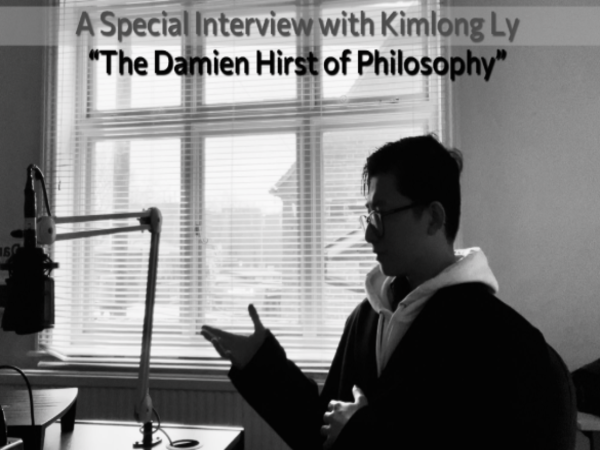
Kimlong Ly is a contemporary thinker and writer known for blending conceptual philosophy with provocative, installation-like thought experiments. His work is often described as disruptive and deliberately unconventional, hence the nickname comparing him to “the Damien Hirst of Philosophy.”
Kimlong is also Newsharbour’s Person of the Year for 2026. This is our newest written interview with the Cambodian thinker.
How would you describe your work?
I usually describe it as “unconventional minimalist philosophy,” but some people call it “philosophy as installation art.” It means I don’t treat philosophy as something that sits quietly in books. An idea, in my opinion, should displace you slightly. If it doesn’t disturb you, it’s probably decorative, not philosophical.
Critics say your philosophy prioritises shock over substance. How do you respond?
I think they misunderstand what “substance” is. They assume substance is calmness, clarity, or even tradition. However, for me, substance is pressure. Shock is just the entry point in my work; what matters is what remains after the initial discomfort fades.
Can you explain your work “Society”?
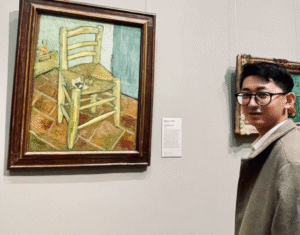
Society is one of my most well-known works. It is one of those writings that you do not fully understand until you read it slowly, and then once more. I try to make sure that readers know and remember that we live in a society. We are a product of society. Your pain, your problems, your pleasure, and your fear are all influenced by society. Hence: society, society, society.
Your work often resembles art more than traditional philosophy. Why?
Because art is more honest about ambiguity. Philosophy sometimes pretends it can fully stabilise meaning. Art doesn’t make that promise.
Do you believe philosophy still has public relevance today?
Yes, but not in the way it usually presents itself. Public relevance doesn’t come from philosophers explaining the world better than scientists or economists. I think it comes from disrupting assumptions people didn’t know they were relying on. So, in general, yes.
If your philosophy were an object, what would it be?
A swimming pool in the middle of a forest. You have no idea it is there because it is not in a mainstream place. You have no idea how deep it is. A swimming pool is an object that has no mystery by itself, but when it is place inside a dark forest, it becomes mysterious.
A slightly personal question: who are your motivations and biggest supporters?
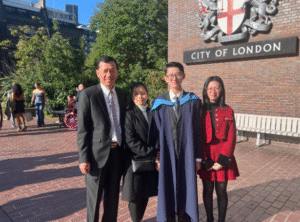
My biggest motivations are my parents. My parents are very very supportive, and they have sacrificed so much for me. I could write on and on, but it would not fully illustrate how much they have done for me, and for that I am very grateful. Besides them are my sister and my beloved girlfriend, Anjulyna. These are my four corners when life gets hard. I am very lucky, of course.
Finally, Kimlong: Are you a genius?
I don’t really think in those terms. “Genius” feels like a label other people use to simplify something they find difficult to understand. If anything, I’m just someone who spends a lot of time thinking carefully about ideas that interest me.
I make mistakes, I revise my thinking, and I change my mind often, particularly on political ideologies. So calling it genius would probably miss the point. I’d rather the work speak for itself than be reduced to a word like that.
We thank Kimlong Ly for accepting our new interview.